
Article
The Amazon on the spice route
Leaves, fruit, bark, roots, oils and resins from the forest fueled the economy and brought wealth to the region during the colonial period
Suzel Tunes, from Pesquisa FAPESP Magazine
The 18th century, in the state of Grão-Pará and Maranhão, which at the time of colonial Brazil represented the present-day Amazon, was the heyday of the commercialization of the drugs of the sertão, as the products collected in the interior of the Amazon rainforest and exported to Europe were then called. Documents from the time, kept in the Public Archives of the State of Pará and transcribed in the Book of Canoes (USP/FAPESP, 1993), record the expeditions that left Belém and went into the Amazonian hinterlands. The aim was to harvest one of the Amazon’s most coveted plant species, cacao, which the Swedish naturalist Carl von Linné, or Lineu (1707-1778), named Theobroma (“food of the gods”) in 1753.
For a voyage that could last eight months, the canoes carried, in addition to food, cotton cloths, tools, liquor and trinkets that could serve as currency to pay the indigenous people who made up the crew and to exchange goods with those who lived in the forest. In the colonial Amazon, cocoa itself was a highly valued currency. “Along with other spices, cocoa was called ‘natural currency’ or ‘money of the land’,” points out historian Rafael Chambouleyron, from the Federal University of Pará (UFPA), organizer of the book As drogas do Sertão e a Amazônia Colonial Portuguesa (History Centre of the University of Lisbon, 2023).
“Chocolate consumption was booming in Europe during this period,” recalls historian Camila Loureiro, from the State University of Campinas (Unicamp), who is carrying out research supported by FAPESP on human action and the environmental impact of colonialism in the Amazon in the 16th to 18th centuries. The indigenous Brazilians consumed the pulp of the fruit, which has a sweet taste, but the Spanish had already brought chocolatl to Europe, a bitter drink made from roasted cocoa beans, created by the peoples of Mesoamerica. To improve the aroma and taste, the Europeans added other spices from the forest, such as the much-loved vanilla pods (Vanilla sp.). According to the researcher, cocoa accounted for 90% of Pará’s exports between 1730 and 1755, a period in which around 15,000 tons of seeds were sent to Europe.
The heated market turned into prosperity. The French naturalist Charles-Marie de La Condamine (1701-1774), who traveled along the Amazon River to measure the length of a one-degree arc along a meridian near the equator, was amazed by the development of Pará, where he arrived in 1743. “It seemed to us, arriving in Pará, and coming out of the forests of the Amazon, to see ourselves transported to Europe,” he wrote in his 1745 book
“Abridged narrative of travels through the interior of South America from the shores of the Pacific Ocean to the coasts of Brazil and Guyana, descending the river of Amazons”. “We found a large city, well-lined streets, bright houses, most of them built 30 years ago in stone and gravel, magnificent churches. Pará’s direct trade with Lisbon, from where a large convoy arrives every year, makes it easy for people of means to provide themselves with all sorts of comforts.”

Brasiliana Iconográfica/Joaquim José Codina
Geopolitical pressure
At the beginning of the 17th century, Portugal no longer dominated the trade in the valuable spices from the Orient; it was facing fierce competition mainly from the Dutch and was looking for substitutes for products such as cloves, nutmeg, cinnamon and pepper. There was also geopolitical pressure to occupy the interior of Brazil, points out historian Christian Fausto Moraes dos Santos, from the State University of Maringá (UEM): “Portugal needed to establish borders with Spain on the American continent and control the territory, within the maxim ‘it’s yours if you’re occupying it'”. According to Santos, this led to the foundation of Belém in 1616, from where the expeditions into the interior of the forest and the ships carrying Amazonian spices to Lisbon would depart.
In the hot and humid forests of Brazil, the Portuguese were sure they would discover plant species analogous to those of South and Southeast Asia. And they ended up finding new flavors and aromas: leaves, fruits, seeds, roots and bark of aromatic trees which, crushed or transformed into oils, resins and tinctures, would have great commercial value as condiments or medicines. “We’ve already identified 36 species exploited by the colonizers in the territory,” says history student Sofia Montaner Preto. Under Loureiro’s guidance and with support from FAPESP, she is surveying the plant species exploited in the Colonial Amazon as part of her scientific initiation project.
They were plants valued for their culinary qualities, medicinal virtues, or both, such as the puxuri (Licaria sp.), which became known as “pará’s nut” due to its aromatic and medicinal properties similar to those of nutmeg. With its peculiar flavor and aroma (reminiscent of a mixture of nutmeg and cardamom), puxuri is still used today in sweet and savory dishes. “It was much appreciated in the 18th-century Amazon as a remedy for gastrointestinal diseases. Based on indigenous knowledge, the Jesuits prepared an infusion of their ground almonds in liquor to treat stomach ailments and dysentery,” explains ethnobotanist Márlia Coelho-Ferreira, from the Emílio Goeldi Museum of Pará.
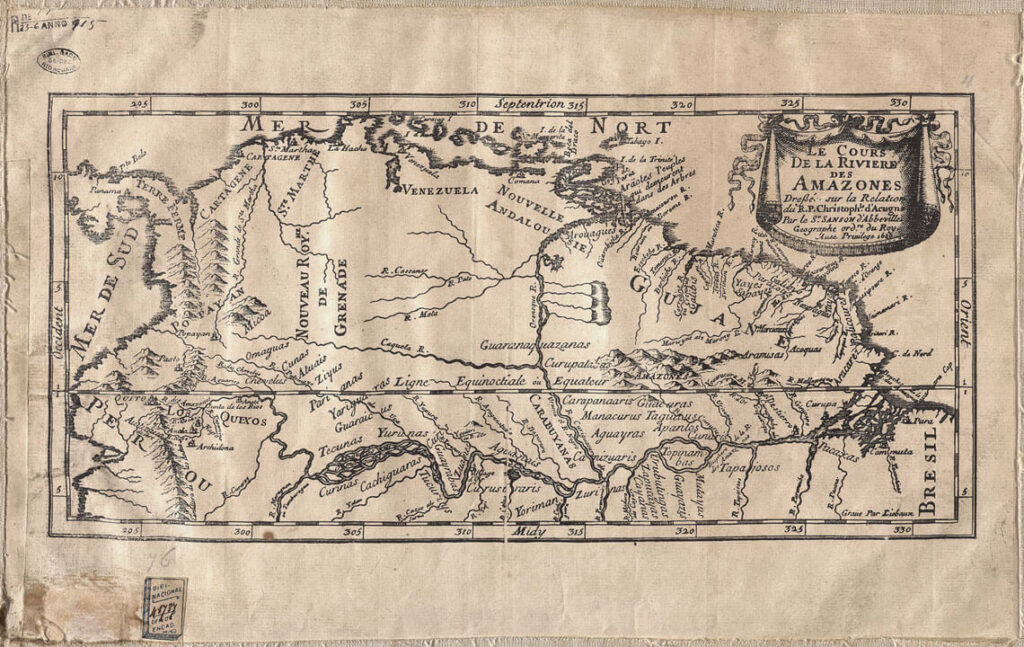
National Library
Another dual-purpose plant was sarsaparilla (Smilax sp.), known by the indigenous people as japecanga. The leaves and fruit were used for food, and the root to make a tea with purifying and diuretic properties. Copaiba and andiroba were also considered medicinal: “The oil-resin extracted from the trunk of the copaibeira [Copaifera sp.] became known as the ‘balm of the Jesuits’ because it was used as a wound-healing, anti-inflammatory and antiseptic. The oil from the seeds of the andiroba [Carapa guianensis] was applied to the body to prevent insect bites and treat rheumatism and breakages [fractures],” summarizes Ferreira.
At that time, apart from cocoa, the Amazonian spice list’s biggest highlight was pau-cravo (Dicypellium caryophyllaceum), a tree whose bark was used mainly in cooking as a spice and digestive aid. Very aromatic, pau-cravo was chosen by the Portuguese as a substitute for cloves (Syzygium aromaticum), and was also called cravo-do-maranhão or cravo-do-pará. “Although it has a different appearance, its flavor is almost the same as the one from India,” said the Conselho Ultramarino (Overseas Council, an organization with financial and administrative powers) when it received specimens of the species in 1646. In Preto’s survey, pau-cravo and cocoa are the most mentioned, with 36% of the records in two volumes of the Livro grosso do Maranhão, a compilation of legislative sources covering the period from 1647 to 1745, published in 1948 in the Anais da Biblioteca Nacional in Rio de Janeiro.
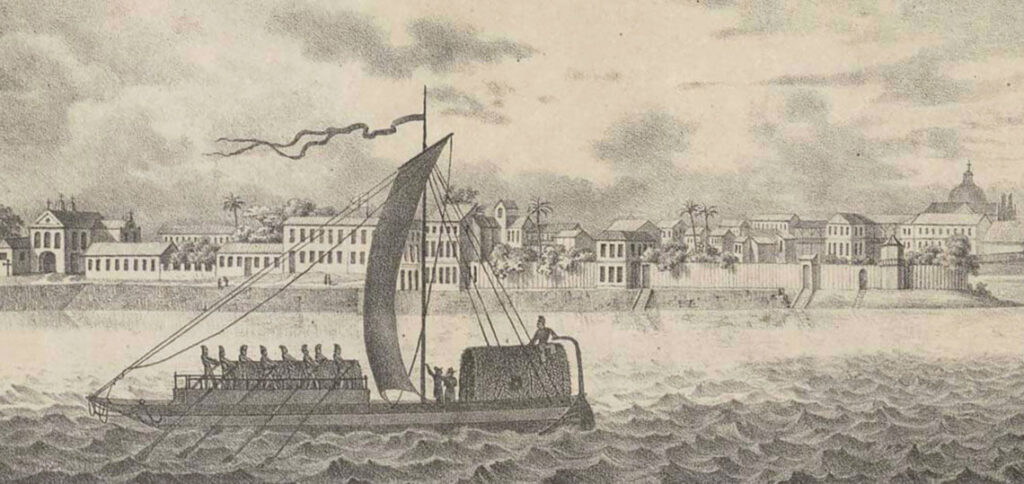
Atlas for travel in Brazil / Spix e Martius
Indigenous impulse
For Chambouleyron, the exploitation of pau-cravo has a peculiarity: unlike other products found in the Amazon rainforest, such as copaiba or andiroba, the Portuguese interest in the spice did not arise from millenary indigenous knowledge, since the original peoples of Brazil were not in the habit of using this aromatic bark. The indigenous people, however, were essential to its exploitation.
The Portuguese were successful in obtaining Amazonian spices because they had knowledge of navigation routes and the manufacture of vessels adapted to the Amazonian river network, canoes that could reach 20 meters in length. “The mastery of the rivers was fundamental; all the indigenous technology of river navigation was incorporated by the Portuguese, re-signified with the use of European tools,” says Chambouleyron.
Also indigenous was the workforce used to exploit the forest, starting with the rowers, then called “remeiros” (paddlers), who guided the canoes through the region’s intricate river network. Each canoe could have between 20 and 50 indigenous persons recruited for this work, usually paid with sticks of cloth, measuring the equivalent of 1.10 meters. They were not, therefore, enslaved, but they performed compulsory labor. According to Loureiro, the indigenous settlers under the tutelage of missionaries were forced to work. And so that they wouldn’t run off into the forest in the middle of the expedition, they were motivated with gifts—liquor, salt, axes and fishhooks, for example—in addition to the agreed salary.

Ignácio Baptista de Moura / Tancredo Neves Cultural and Tourist Center / Wikimedia commons
According to an article by the Unicamp historian published in 2019 in the Estudos Avançados magazine, together, women and children (boys and girls up to the age of 14) made up 84% of the enslaved population. Women and children were responsible for the agricultural activities that were vital for feeding and paying the workers, as well as acquiring more captives. Although laws were passed in the 17th century prohibiting the enslavement of indigenous people, there were still legal means of obtaining native slaves. One of these was the so-called ransom, the acquisition of indigenous people taken prisoner in inter-ethnic conflicts. Saved from sacrifice, they owed their lives to those who rescued them.
After centuries of exploitation, the pau-cravo is among the species most seriously threatened with extinction. According to Ferreira, a 2012 study found only two populations of the species in Pará, in the municipalities of Vitória do Xingu and Juruti. Later, the pau-cravo was also recorded in the municipalities of Moju and Senador José Porfírio.
Other Amazonian species continue to be exploited to this day. “The volume of drugs of the sertão has always been small compared to commodities like sugar, for example, but it has grown over time,” explains Loureiro. Medicinal plants have also continued to play an important role in the Amazon region, especially in folk medicine, and several are currently the subject of scientific research.
“Many therapeutic properties have been proven and others are being discovered in the light of current scientific research methods,” says Ferreira. Studies on the casca-preciosa (Aniba canelilla) are a good example. “Pre-clinical studies show that the oil extracted from the bark has relaxing effects on intestinal smooth muscle, justifying the use of the plant for gastrointestinal disorders, as well as cardiovascular effects.”
For Santos, the exploitation of Amazonian spices in the colonial period, although mostly predatory, had the merit of recognizing the economic potential of the region, which has often been forgotten throughout history. Even today, in his opinion, there is a lack of investment aimed at the sustainable development of the region, which would promote and organize this activity: “With investment in technology, it would be possible to transform the Amazon while keeping the forest standing.”
The article above was published under the title “Dinheiro da terra” (Money from the Land) in the print edition of Pesquisa FAPESP Magazine No. 344, October 2024.
Projects
1. Entre um passado profundo e um futuro iminente: Ação humana e impacto ambiental do colonialismo moderno na Amazônia (séculos XVI a XVIII) (nº 22/02896-0); Modalidade Auxílio à Pesquisa – Projeto Inicial; Pesquisadora responsável Camila Loureiro Dias (Unicamp); Investimento R$ 763.123,36.
2. Conhecimentos indígenas das plantas na Amazônia colonial (séculos XVII e XVIII) (nº 24/01523-1); Modalidade Bolsas no Brasil – Doutorado; Pesquisadora responsável Camila Loureiro Dias (Unicamp); Beneficiário Talles Manoel da Silva; Investimento R$ 362.995,20.
3. As drogas do sertão: Levantamento de ocorrências das espécies vegetais nos relatos de viagens e crônicas coloniais (nº 24/05635-9); Modalidade Iniciação Científica; Pesquisadora responsável: Camila Loureiro Dias (Unicamp); Beneficiária Sofia Montaner Preto; Investimento R$ 13.594,68.
Scientific articles
DIAS, C. L. Os índios, a Amazônia e os conceitos de escravidão e liberdade. Estudos Avançados. v. 33, n. 97. 2019.
DONINI, C. V. et al. Flores e cascas: Exploração de cravo, Dicypellium caryophyllaceum e Syzygium aromaticum, no século XVIII. VIII Congresso Internacional de História. Maringá, Universidade Estadual de Maringá, 2017 (Simpósio História, Ciências e Ambiente).
MEDEIROS, M. F. T. et al. Histórico e o uso da “salsa parrilha” (Smilax spp.) pelos boticários no Mosteiro de São Bento. Revista Brasileira de Biociências. v. 5, n S1. jul. 2007.
Books
CHAMBOULEYRON, R. (org). As drogas do sertão e a Amazônia colonial portuguesa. Lisboa: Centro de História da Universidade de Lisboa, 2023. Acessível em: Repositório da Universidade de Lisboa:
DANIEL, J. Tesouro descoberto no máximo rio Amazonas (1722-1776). Rio de Janeiro: Contraponto, 2004. FERREIRA, A. R. Viagem filosófica pelas capitanias do Grão Pará, Rio Negro, Mato Grosso e Cuiabá 1783 -1792. Rio de Janeiro: Conselho Federal de Cultura, 1971.
LA CONAMINE, C.-M. de Viagem na América Meridional descendo o rio das Amazonas. Brasília: Senado Federal, 2000 (Coleção O Brasil visto por estrangeiros).
This text was originally published by Pesquisa FAPESP under the Creative Commons CC-BY-NC-ND license. Read the original here.